The study of Wuthering Heights has evolved significantly since its initial publication in 1847, transitioning from early dismissals of its "coarse" and "brutal" elements to sophisticated analyses of its complex narrative structure, psychological depth, and thematic richness. Emily Brontë’s sole novel has become a cornerstone of English literature, inspiring diverse critical approaches that reflect changing literary and cultural trends. This review synthesizes key scholarly discussions, exploring thematic concerns, narrative techniques, character analysis, and contemporary theoretical frameworks.
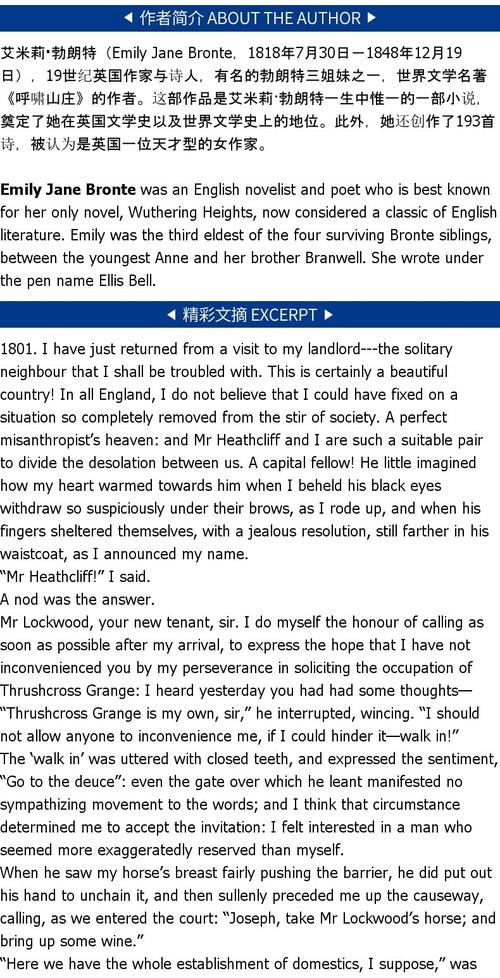
Early criticism of Wuthering Heights often focused on its perceived immorality and deviation from Victorian norms. Critics like Elizabeth Rigby condemned its "ungodly" characters and lack of moral resolution, failing to recognize its deliberate subversion of conventional romanticism. However, by the early 20th century, modernist critics such as Q.D. Leavis began to appreciate its formal innovations, particularly its dual-narrative structure. Lockwood’s frame narrative and Nelly Dean’s embedded tale create a complex web of perspectives, challenging readers to question reliability and truth. This layered narration, scholars argue, mirrors the novel’s central themes of perception and illusion, as characters grapple with their own biases and the distortions of memory.
Thematic analysis has long centered on the novel’s exploration of love, passion, and revenge. While Catherine and Heathcliff’s bond is often romanticized as a transcendent "eternal love," feminist critics like Sandra Gilbert and Susan Gubar have reinterpreted it through a lens of psychological and social oppression. They argue that Catherine’s declaration, "I am Heathcliff," reflects a destructive fusion of identities rooted in childhood trauma rather than a healthy partnership. Similarly, Heathcliff’s revenge is examined not as mere villainy but as a response to systemic oppression—his status as an orphaned outsider fuels his quest to dismantle the class structures that marginalized him. Postcolonial theorists have further expanded this discussion, analyzing Heathcliff’s ambiguous racial and ethnic identity as a symbol of colonial disruption, challenging the novel’s setting as a microcosm of English society’s internal conflicts.
Character studies have also evolved beyond simplistic categorizations of heroes and villains. Heathcliff, in particular, has been reimagined as a Byronic anti-hero whose savagery is inseparable from his vulnerability. Critics like John Bowen emphasize his role as a "dark double" to the Earnshaws and Lintons, embodying their repressed desires and societal hypocrisies. Catherine, meanwhile, is celebrated as a proto-feminist figure whose struggle between domestic duty and personal desire anticipates later literary heroines. Her psychological turmoil, as analyzed by critics like Terry Eagleton, stems from the constraints of patriarchal expectations, which demand she suppress her wild, untamed nature to conform to the role of a "lady."
In recent decades, ecocritical and psychoanalytic approaches have offered fresh insights. Ecocritics such as Kate Rigby examine the novel’s moorland setting as an active, sentient force that shapes the characters’ destinies. The wild, untamed landscape contrasts with the cultivated order of Thrushcross Grange, symbolizing the conflict between nature and civilization. Psychoanalytic readings, drawing on Freudian and Lacanian theories, delve into the characters’ unconscious desires and familial dynamics. Heathcliff’s obsession with Catherine is interpreted as a manifestation of the death drive, while the recurring motif of windows and doors (e.g., Catherine’s ghost at the window) represents the permeability between the conscious and unconscious mind.
The following table summarizes major critical approaches to Wuthering Heights:
| Critical Approach | Key Focus | Notable Scholars | Core Arguments |
|---|---|---|---|
| Formalist/Narrative Analysis | Dual-narrative structure, reliability of narration | Q.D. Leavis, Peter Brooks | The layered narrative challenges truth and perception, emphasizing subjectivity. |
| Feminist/Gender Studies | Female agency, patriarchal constraints | Sandra Gilbert, Susan Gubar | Catherine’s struggle reflects the oppression of women in Victorian society. |
| Postcolonial Theory | Heathcliff’s identity, class and power dynamics | Gayatri Spivak, Bill Ashcroft | Heathcliff embodies colonial disruption and the destabilization of social hierarchies. |
| Psychoanalytic Criticism | Unconscious desires, trauma, family dynamics | Terry Eagleton, Juliet McMaster | Characters’ actions are driven by repressed psychological conflicts. |
| Ecocriticism | The moorland as a character, nature vs. civilization | Kate Rigby, Greg Garrard | The landscape shapes the narrative and symbolizes existential conflict. |
Despite the wealth of scholarship, debates persist. Some critics argue that the novel’s ambiguous ending—Heathcliff’s death and the potential for harmony between the younger generation—undermines its darker themes, while others see it as a hopeful resolution. Additionally, the reliability of Nelly Dean as a narrator continues to be scrutinized, with scholars questioning her biases and role in manipulating the story’s trajectory.
In conclusion, Wuthering Heights remains a fertile ground for literary analysis, its enduring appeal stemming from its exploration of timeless human conflicts. From early moralistic critiques to postmodern deconstructions, the novel’s complexity ensures its relevance across eras. As critical methodologies continue to evolve, so too will our understanding of Brontë’s masterpiece, which continues to challenge and captivate readers worldwide.
FAQs

-
Q: Why is Wuthering Heights often considered a subversion of Victorian romanticism?
A: Unlike typical Victorian romances that prioritize moral order and societal harmony, Wuthering Heights celebrates destructive passion and defies conventional happy endings. Its anti-heroes, Heathcliff and Catherine, embody raw, often immoral emotions, challenging Victorian ideals of propriety and redemption. The novel’s bleak setting and unresolved conflicts further distinguish it from the optimistic, sentimental romances of the era. -
Q: How does the dual-narrative structure enhance the novel’s themes?
A: The frame narrative, featuring Lockwood and Nelly Dean, creates a layered storytelling effect that mirrors themes of perception and subjectivity. Nelly’s biased perspective and Lockwood’s misinterpretations force readers to question the "truth" of the story, emphasizing how personal and cultural biases shape reality. This structure also highlights the novel’s preoccupation with memory and storytelling, as the past is reconstructed through fragmented, unreliable accounts.